
Pre-Cut Vegetables vs In-House Prep: What Really Saves a Commercial Kitchen Money?
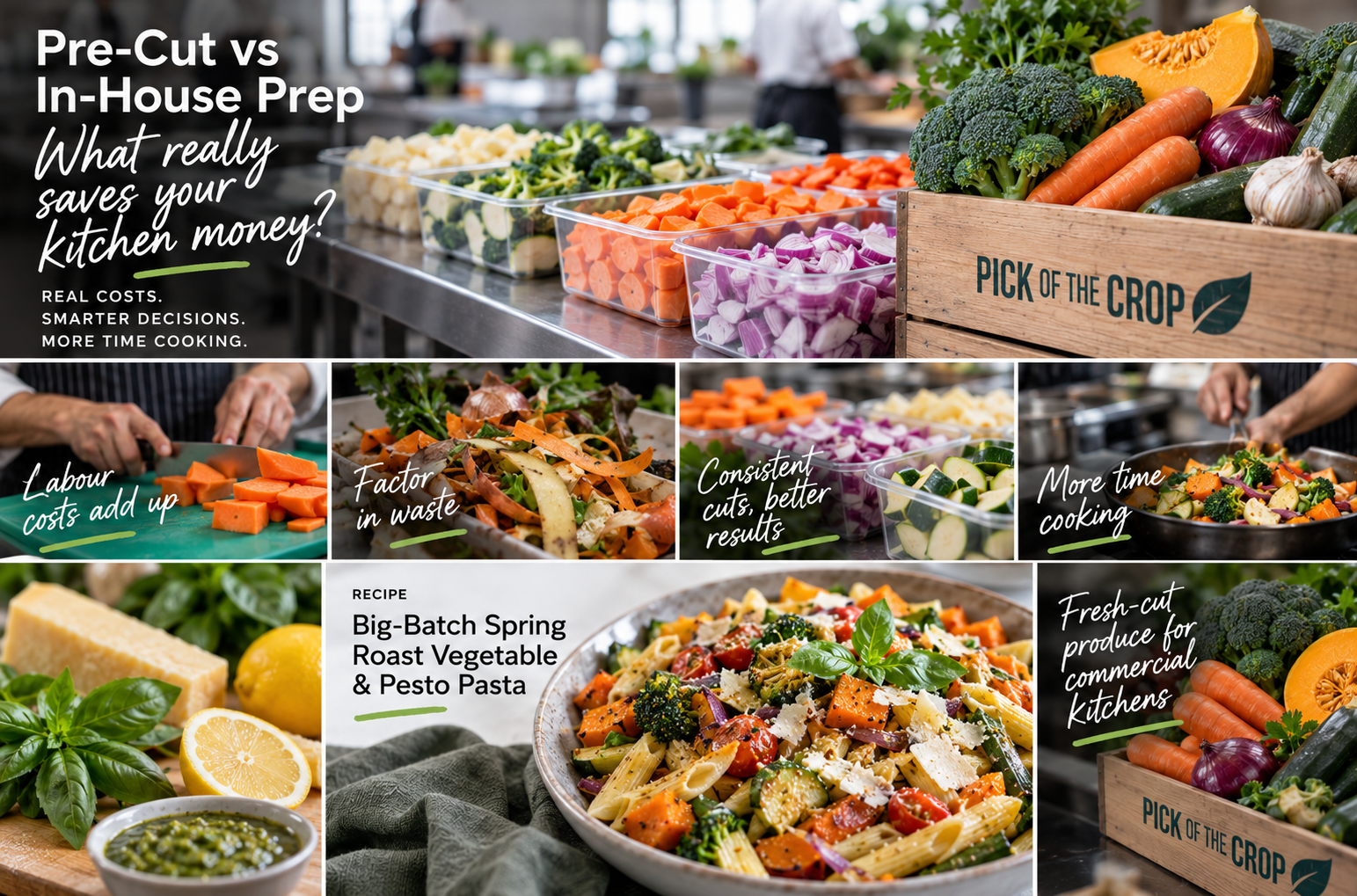
There are few sights more wholesome than a chef standing over a mountain of fresh vegetables, knife in hand, lovingly preparing everything from scratch.
There are also few sights more expensive.
Because while a whole pumpkin might look cheaper on an invoice than a bag of diced pumpkin, the invoice isn't telling you the whole story.
Someone still has to pick it up.
Wash it.
Peel it.
Deseed it.
Chop it.
Clean the bench.
Clean the knife.
Clean the chopping board.
Dispose of the waste.
And, ideally, emerge from the experience with all ten fingers.
Suddenly, that “cheap” pumpkin has developed quite an entourage.
For commercial kitchens dealing with serious volumes of fresh produce, the real question isn't simply:
What's the cheapest price per kilo?
It's:
What's the actual cost of getting that kilo onto the plate?
And that's where the argument for fresh-cut and prepared vegetables gets considerably more interesting.
The $30 box that doesn't really cost $30
Let's say you've bought a box of whole vegetables.
The price looks great.
Excellent work, procurement.
Except the moment that box enters the kitchen, you're adding costs that don't appear anywhere on the supplier invoice.
There is labour.
There is preparation time.
There is waste.
There is cleaning.
There is storage.
And there is yield, because the weight you purchase isn't necessarily the weight you eventually serve.
Take pumpkin.
You're paying for skin.
You're paying for seeds.
You're paying for stalk.
Then you're paying someone to remove all of it.
The same principle applies to onions, potatoes, carrots, cauliflower and plenty of other fresh vegetables.
That's not an argument for buying everything pre-cut.
Far from it.
It's an argument for comparing usable product with usable product, rather than simply comparing the price printed beside “per kilogram”.
Because sometimes the apparently more expensive option is doing considerably more work before it reaches your cool room.
Then there's labour
This is the big one.
If a chef spends an hour preparing vegetables, that hour has a cost.
If three people spend an hour doing it, congratulations: you've now bought three hours of vegetable preparation.
And in a commercial kitchen, those hours compete with everything else that needs doing.
Sauces need making.
Proteins need portioning.
Deliveries need putting away.
Service needs prepping.
Function food needs producing.
And somewhere, somebody has just discovered you need another 15 kilos of carrots.
Excellent.
When you're operating at scale, repetitive preparation can consume a surprising amount of kitchen labour.
That's why the question shouldn't necessarily be:
“Can our kitchen chop this?”
Of course it can.
The better question is:
“Is this the best use of our team's time?”
That's a very different conversation.
Pre-cut doesn't mean processed beyond recognition
There's sometimes a strange assumption that “prepared vegetables” means something has happened to them in a mysterious factory involving seventeen ingredients and a laboratory coat.
We're talking about carrots.
Someone else has chopped them.
Fresh-cut vegetables are exactly what they sound like: fresh produce that has been washed, peeled, trimmed, sliced, diced or otherwise prepared before it arrives in your kitchen.
Depending on your requirements, PICK OF THE CROP can supply vegetables in different cuts and specifications to suit commercial food preparation.
Think diced pumpkin ready for roasting.
Sliced carrots ready for the tray.
Prepared potatoes.
Chopped onions.
Vegetables portioned and ready to hit the pan rather than the chopping board.
You're not outsourcing the cooking.
You're outsourcing some of the repetitive stuff that happens before the cooking can begin.
Your chefs can cope without the character-building experience of peeling 200 carrots before lunch.
We promise.
The bit everyone forgets: yield
This is where the maths becomes particularly important.
Imagine you purchase 10 kilograms of a vegetable.
You don't necessarily serve 10 kilograms.
Once you've peeled it, trimmed it and removed the unusable portions, your usable yield might be considerably lower.
If 15% disappears during preparation, your 10 kilograms has become 8.5 kilograms of usable produce.
If 25% disappears, you've got 7.5 kilograms.
And you've paid somebody to create the waste.
That's why comparing whole produce against prepared produce purely on price per kilo can be misleading.
A better comparison is:
How much does each kilogram of usable, service-ready produce actually cost the kitchen?
Suddenly, the gap can become much smaller.
Sometimes it disappears altogether.
And sometimes (ok, let’s be honest…very often) prepared produce wins.
Consistency has a value too
Ask three people to dice a carrot into “roughly 10-millimetre pieces” and you may discover three fascinating interpretations of 10 millimetres.
In some kitchens, that doesn't matter.
In others, it absolutely does.
Consistent cuts mean more predictable cooking.
A tray of vegetables cut to roughly the same size will generally cook more evenly than one containing everything from tiny cubes to something resembling half a carrot.
That matters when you're producing large volumes.
It's particularly relevant for catering, healthcare, aged care, education and other environments where portion consistency and repeatability matter.
It can also make plating easier.
And costing easier.
And training easier.
Nobody has to stand there explaining for the seventh time that “diced” doesn't mean “whatever shape speaks to you spiritually”.
Waste isn't just what goes in the bin
Food waste gets plenty of attention and, rightly so.
But commercial kitchens also need to think about what happens around that waste.
Peelings and trimmings take up bin space.
Bins need emptying.
Prep areas need cleaning.
Organic waste needs handling.
And if you're regularly processing large quantities of vegetables, that volume adds up remarkably quickly.
Prepared vegetables shift much of that processing away from your kitchen.
That can mean less prep waste entering the premises and less time spent dealing with it.
Again, we're not suggesting your kitchen bin is about to become an endangered species.
We're simply saying it may get a little less exercise.
So should commercial kitchens buy everything pre-cut?
No.
And anyone telling you otherwise is probably trying to sell you something.
There are plenty of situations where whole produce makes perfect sense.
If volumes are low, prep is quick and your team has capacity, whole vegetables may absolutely be the better option.
Some ingredients also simply don't benefit much from being prepared in advance.
And chefs will understandably want complete control over certain cuts, finishes and applications.
The opportunity is to identify the high-volume, repetitive, labour-heavy jobs.
That's where prepared vegetables can start earning their keep.
Look at what your kitchen processes every week.
Twenty kilos of pumpkin?
Thirty kilos of potatoes?
Boxes of carrots?
Onions by the sack?
Those are the places worth doing the maths.
Don't outsource the knife work because you can.
Outsource the knife work where it makes commercial sense.
The five-minute kitchen audit
Here's something useful you can actually do after reading this.
Take a look at the five vegetables your kitchen prepares in the highest volume.
For each one, ask:
How many kilograms do we buy?
How long does preparation actually take?
Who is doing that preparation, and what does that labour cost?
How much product is lost through peeling, trimming and waste?
Could we purchase it prepared to the specification we actually use?
You might be surprised by what those numbers reveal.
Because saving 20 minutes sounds irrelevant.
Saving 20 minutes on the same job, six days a week, 52 weeks a year?
That's more than 100 hours.
Now we're talking.
Stop guessing. We've done the spreadsheet for you.
Yes, we've actually made you a spreadsheet.
But before you start having flashbacks to complicated formulas and accounting classes, this one's refreshingly simple.
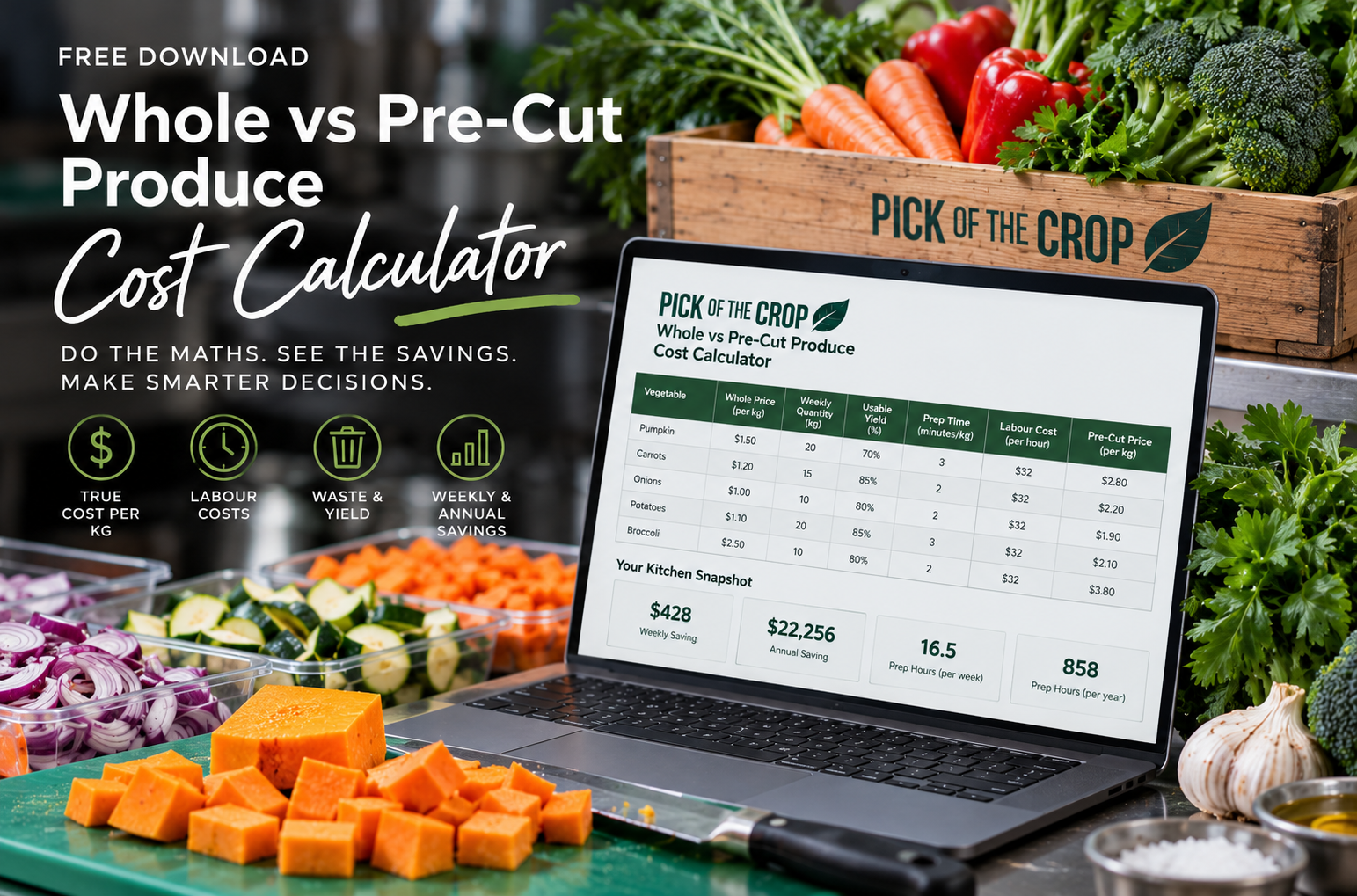
We've created a FREE Whole vs Pre-Cut Produce Cost Calculator to help commercial kitchens work out what they're really spending on vegetable preparation.
Simply enter your produce prices, weekly quantities, preparation time, labour costs and estimated waste. Then compare those figures against the cost of buying the same vegetables pre-cut.
The calculator does the rest.
It'll show you your true cost per usable kilogram, the cost of preparing vegetables in-house, potential weekly and annual savings, and how many hours your kitchen is currently spending on vegetable prep.
No complicated formulas. No accounting degree required.
We've done the maths so you don't have to.
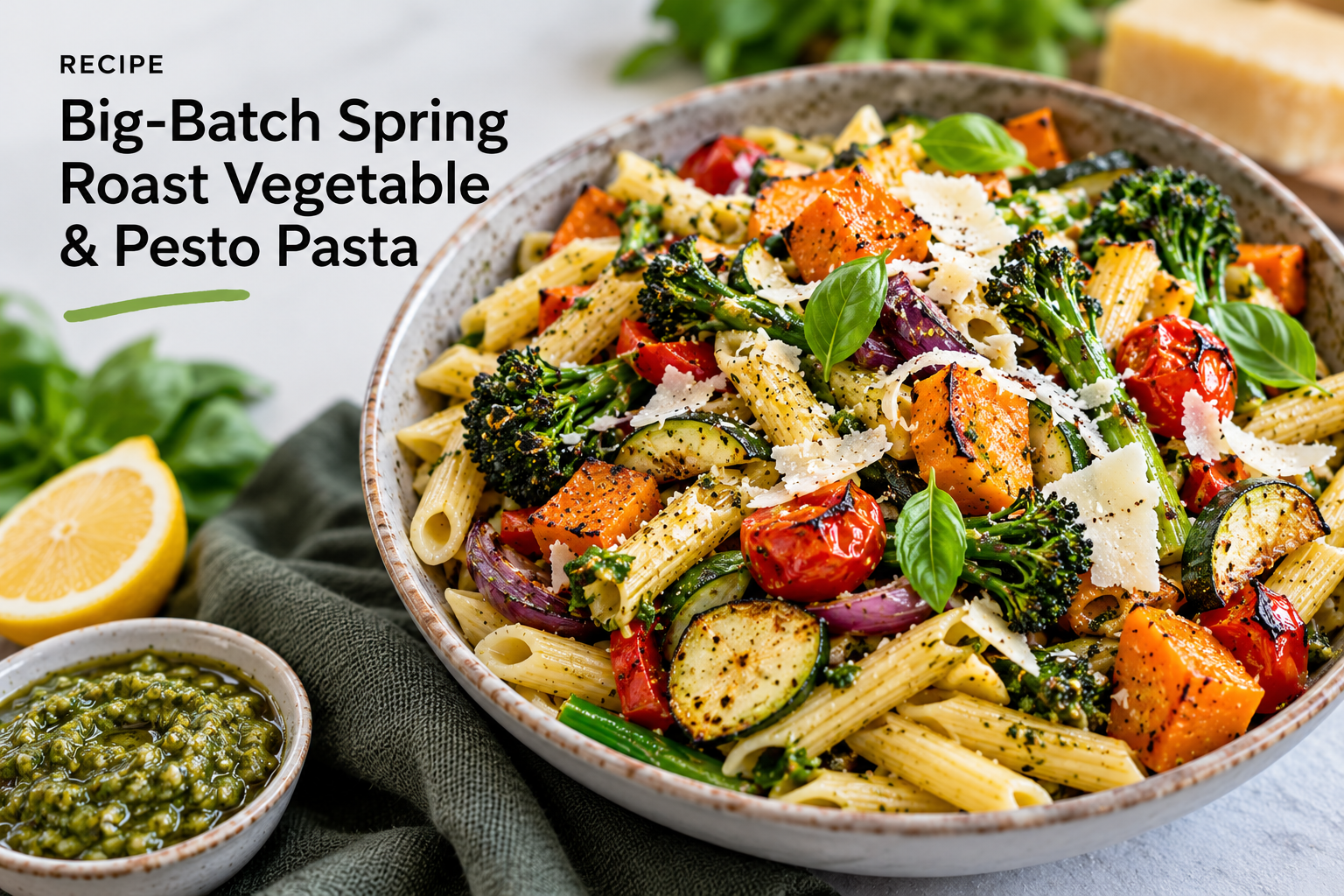
Recipe: Big-Batch Spring Roast Vegetable & Pesto Pasta
If we're going to talk about reducing vegetable prep, we should probably give you something that puts the theory to work.
This Spring Roast Vegetable & Pesto Pasta is designed for approximately 20 serves, uses plenty of fresh vegetables and works beautifully for catering, clubs, cafés, education and other high-volume kitchens.
And yes… almost all of the tedious chopping can be done before the produce reaches you.
You'll need
1.5 kg diced pumpkin
1 kg sliced zucchini
750 g sliced capsicum
750 g broccoli florets
500 g sliced red onion
500 g cherry tomatoes
2 kg penne or rigatoni
500 g basil pesto
250 ml extra virgin olive oil
Juice and zest of 3 lemons
300 g baby spinach
300 g grated or shaved parmesan
Fresh basil
Salt and cracked pepper
Get it done
Heat the oven to 200°C.
Spread the pumpkin, zucchini, capsicum, broccoli and red onion across lined trays. Add a little olive oil, season well and roast until tender and beginning to caramelise.
Add the cherry tomatoes towards the end. We want them blistered and juicy, not cremated.
Cook the pasta until just al dente, reserving a little of the cooking water before draining.
Combine the pesto, lemon juice, zest and a splash of the pasta water to loosen the sauce.
Toss through the pasta, roasted vegetables and baby spinach.
Finish with parmesan, fresh basil and cracked pepper.
Serve immediately, or chill it down and turn it into a spring pasta salad for catering.
Make it work harder
This is one of those useful base recipes that can become several different meals without causing an identity crisis.
Add grilled chicken.
Add chickpeas.
Swap pesto for a lemon and herb dressing.
Add feta instead of parmesan.
Change the vegetables depending on what's particularly good that week.
Serve it hot.
Serve it cold.
Use it as a main.
Use it as a side.
And because the pumpkin, zucchini, capsicum, broccoli and onion can potentially arrive already prepared, you've got a high-volume fresh vegetable dish without starting your morning staring at a mountain of chopping.
Which feels rather appropriate.
So, whole or pre-cut?
The answer isn't one or the other. It's whatever makes sense for the job.
Whole produce gives chefs complete flexibility and will always have an important place in commercial kitchens.
Prepared produce solves a different problem. It can reduce repetitive prep, improve consistency, reduce preparation waste and give valuable kitchen hours back to your team.
And when labour is one of the biggest costs in foodservice, those hours matter.
So the next time you're comparing the price of whole vegetables with fresh-cut vegetables, don't stop at the number on the invoice.
Look at what happens after the box arrives.
Because sometimes the cheapest vegetable isn't actually the cheapest vegetable at all.
PICK OF THE CROP supplies wholesale fruit and vegetables across Sydney, including fresh-cut and prepared vegetables for restaurants, cafés, clubs, caterers, aged care, healthcare, education and other commercial kitchens.
Whether you want it whole, sliced, diced, peeled or prepared to specification, talk to the PICK OF THE CROP team about what makes sense for your kitchen.
Less time chopping. More time cooking.